What Should We Consider When Choosing a CRM?
- Identify Your Business’s Needs
- Goals and Processes
- Departmental Involvement
- Technological Compatibility and Integration
- Integration with Existing Systems
- Mobile Access and Cloud-Based Solutions
- The Potential of Artificial Intelligence and Automation
- User Experience and Training
- Interface and Ease of Use
- Training and Support
- Cost and Return on Investment (ROI)
- Hidden Costs
- Data Security and Privacy
- Scalability and Flexibility
- Vendor Support and References
- Conclusion: Strengthen Your Digital Transformation with the Right CRM Choice
What to Consider When Choosing a CRM: A Guide to Finding the Best Solution for Your Business
In today’s competitive business world, customer relationship management (CRM) strategies are critical to a company’s success. The right CRM solution is the key to boosting sales and productivity while increasing customer satisfaction. However, with so many options on the market, the question of what to look for when choosing a CRM can be confusing for many business owners.
In this guide, we’ll take a detailed look at the key factors you should consider when selecting the customer relationship management (CRM) system that best fits your business’s specific needs. With this information to help you take the right step on your digital transformation journey, you can make a sound investment.
Identify Your Business’s Needs
Every business has its own unique operational processes and goals. Therefore, before investing in a CRM system, it is essential to clearly define your current situation and future expectations. A needs analysis is the first and most important step in making the right choice.
Goals and Processes
Determine what you expect from a CRM and which business processes you want to improve. Clarify which departments such as sales, marketing, customer service, or technical support—will use the CRM. This will help you find a system with the right feature set.
Do you want to optimize your sales processes?
Are you aiming to increase the effectiveness of your marketing campaigns?
Do you want to reduce customer service response times?
Do you need better reporting and analytics capabilities?
Departmental Involvement
Gather feedback from all departments that will be using the CRM. Their expectations and daily workflows will ensure that the selected system is user-friendly and functional. Adoption of the solution by all stakeholders is critical to the project’s success.
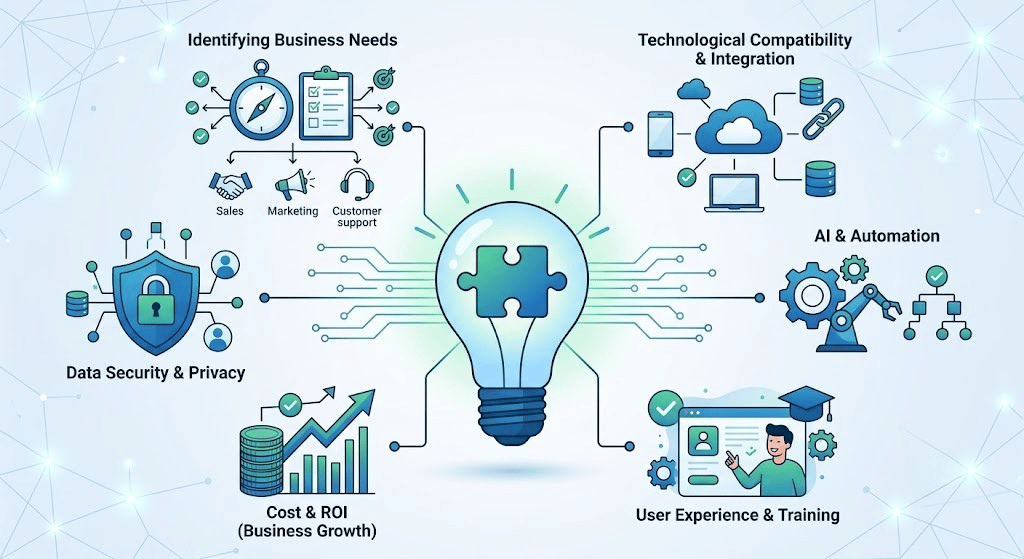
Technological Compatibility and Integration
It is crucial that the CRM you choose is compatible with your existing technology infrastructure and can integrate seamlessly with your other business tools. This ensures data consistency and uninterrupted workflows.
Integration with Existing Systems
Evaluate how the CRM will integrate with your existing systems, such as your accounting software, ERP system, or e-commerce platform. Seamless integration reduces data entry and increases operational efficiency. If you have specific integration needs, our web development services can assist you.
Mobile Access and Cloud-Based Solutions
Today, mobile access and cloud-based solutions are indispensable. Allowing your team to access CRM data from anywhere and on any device provides a critical advantage, especially for field sales teams. Cloud-based CRMs reduce maintenance burdens and offer scalability.
The Potential of Artificial Intelligence and Automation
Advanced CRM systems offer artificial intelligence (AI) and automation capabilities. These features save time by automating repetitive tasks and provide more personalized experiences by analyzing customer behavior. It would be wise to choose a CRM with the potential for AI integration in line with your business’s future growth goals.
User Experience and Training
Even the most comprehensive CRM cannot be successful if it is not adopted by your employees. A user-friendly interface and adequate training ensure that the system is used effectively.
Interface and Ease of Use
The system’s interface should be intuitive and easy to understand. A complex and difficult-to-use CRM can lower employee motivation and reduce adoption rates. Test the user experiences of different CRMs by using trial versions.
Training and Support
The training and support services offered by the CRM provider are very important. Post-implementation training helps your employees learn the system quickly and use it efficiently. Technical support provides quick solutions to potential issues.
Cost and Return on Investment (ROI)
The cost of a CRM investment is not limited to the initial licensing fees. You should carefully calculate the total cost of ownership and the expected return on investment (ROI).
Hidden Costs
In addition to licensing fees, consider the costs of implementation, customization, training, maintenance, and potential integration. These hidden costs could cause you to exceed your budget. Also, evaluate the time and resource savings the system will bring to your business.
Data Security and Privacy
Customer data is one of your business’s most valuable assets. Therefore, it is critical that the CRM solution you choose has robust data security and privacy protocols. Data encryption, backup, and protection against unauthorized access are fundamental requirements. For more information on data privacy and security, you can review Google’s Business Insights page.
Scalability and Flexibility
As your business grows, your CRM needs will change. The system you choose must be scalable and flexible enough to adapt to your future growth plans. The ability to add new features, increase the number of users, and expand with different modules is essential.
Vendor Support and References
The CRM provider’s reputation and customer support are also key factors. A good provider doesn’t just sell a product—it also supports you as a long-term business partner. It’s helpful to check customer references and research the provider’s industry experience. You can see the benefits of working with us by reviewing our reference projects.
Conclusion: Strengthen Your Digital Transformation with the Right CRM Choice
The answer to the question “What should we consider when choosing a CRM?” depends on your business’s specific needs, budget, and growth goals. With thorough research and proper analysis, you can take a significant step forward on your business’s digital transformation journey. Remember, the right CRM investment is not just a software purchase—it’s a strategic decision that will strengthen your customer relationships.
Contact us to learn more about the CRM solution best suited for your business and to accelerate your digital transformation processes. Our team of experts is ready to support you with solutions tailored to your needs!